If you’ve been specifying or installing rubber acoustic mats on multi-residential projects, you know the headaches. An extra layer to source, cut and fit. Edges that won’t sit right around drains and corners. Floor build-up that creeps past what the drawings allowed for. And still, a defect call two years later because the mat shifted or the bond failed.
Rubber mats work, and they’re familiar — but familiar isn’t the same as optimal. For tile-on-concrete acoustic applications, there’s now a cleaner, more reliable solution that eliminates the mat layer entirely.
It’s called ADH-77 Soundflex, and it does the acoustic work inside the adhesive bed.
Why Acoustic Compliance Is Getting Harder to Ignore
Australia’s apartment pipeline has never been denser. With the NCC mandating acoustic performance in multi-residential construction, specifiers and builders can no longer treat compliance as an afterthought. The BCA requires tiled floors in apartments to meet Ln,w + CI standards — and a traditional adhesive won’t get you there.
The conventional fix is a decoupling layer — typically a 3mm or 5mm rubber mat between the screed and the tile. It achieves the required isolation, but introduces complexity at every stage of the job.
The Problem With Rubber Mat Systems
Let’s be direct about the limitations, because they accumulate across a project.
1. Floor Build-Up
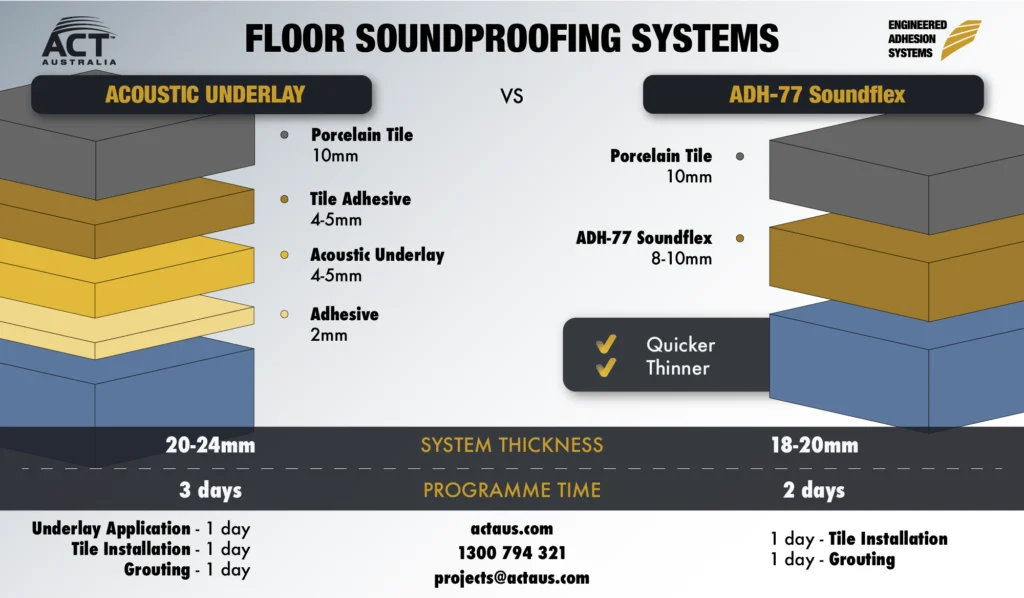
Every millimetre matters in apartment construction. A 3–5mm rubber mat — plus adhesive above and below — adds meaningful height to the floor build-up, flowing through to door clearances, threshold details and wet area falls.
2. Installation Complexity and Handling
The mat needs to be measured, cut and fitted before a tile goes down. Around floor wastes, pipes and wall junctions, fiddly cuts are easy to get wrong — and any gaps or lifting edges become potential failure points beneath the tile.
On high-rise projects, the logistics compound the problem. Heavy rolls of acoustic mat typically require two people to lift and manoeuvre — up stairwells, through common areas, into narrow lifts. That’s additional handling time and labour cost on every floor, before a single tile goes down.
3. Bonding Risk
Tiling over rubber or foam is a different proposition to tiling over a cementitious surface. Not all adhesives are compatible, and the risk of long-term delamination — especially with large-format tiles and heavy traffic — is higher than it should be. The mat itself becomes an interface that can fail.
4. Drummy Tiles and Hollow Sound
Tiling over a compliant rubber substrate makes it harder to achieve full adhesive contact beneath every tile. Any voids or areas of thin bond create acoustic chambers — and those chambers produce the unmistakable hollow knock when a tile is tapped. Drummy tiles are one of the most common triggers for defect disputes and rectification costs on apartment projects, and mat systems increase that risk.
5. Extra Procurement and Coordination
A mat system means an extra product to source, schedule and deliver. On a tight programme, that’s one more thing that can delay a job completion.
ADH-77 Soundflex: Acoustic Performance Built Into the Adhesive
ACT Australia developed ADH-77 Soundflex System specifically to solve these problems. It’s a premium C2TS2-rated, one-part acoustic tile adhesive that delivers BCA-compliant impact sound reduction — without a mat layer beneath the tiles.
The acoustic performance comes from the adhesive bed itself. Applied with the purpose-made ADH-77 Modified 15mm Trowel, the product creates a continuous, resilient bed of minimum 8mm beneath the tile — and it’s that bed that absorbs and decouples the impact energy, rather than a separate rubber layer.
It bonds directly to the full range of substrates you encounter on multi-residential projects — including concrete, sand and cement screeds, and bedding compounds — with no intermediate layer required. Green screeds are suitable after just 24 hours. It is also compatible with ACT WP-1 Pink under-tile waterproofing membrane, so the acoustic and waterproofing systems work from the same manufacturer. ADH-77 Soundflex has been independently CSIRO tested and exceeds BCA requirements for impact sound control in residential apartment buildings. That’s not marketing language — that’s a verified acoustic result with a documented test report behind it.
ADH-77 Soundflex at a glance
| Rating | C2TS2 — highly deformable with high adhesion strength |
| Coverage | 1.5–2 m² per 13 kg bag |
| Required Trowel | ADH-77 Modified 15mm Trowel (purpose-made) |
| Minimum Bed | 8mm continuous |
| Acoustic Testing | CSIRO verified, BCA compliant |
| Substrates | Concrete, screed, bedding compound, green screed, render, FC sheet, plasterboard |
| Wet Areas | Compatible with ACT WP-1 Pink waterproofing membrane |
| VOC | <1 g/L – GreenStar Compliant |
| Warranty | 15 years — ACT Australia |
What This Means on Site
For tilers, the simplification is immediate. Once the substrate is prepared, you go straight to tile installation with ADH-77 and the modified trowel — no mat to fit, no extra layer to manage, no additional interface to worry about. The trowel geometry produces the correct bed depth consistently, which is how acoustic performance is achieved and reproduced reliably across every square metre.
The time saving is substantial. A tiled floor that would typically take three days under a mat system — mat installation, adhesive cure, then tiling — can be completed in a single day with ADH-77 Soundflex. Across a multi-storey project, that reduction in programme time and labour cost adds up fast.
Logistics are simpler too. A 13 kg bag of ADH-77 Soundflex is a one-person carry — up stairwells, in the lift, onto any floor. There’s no two-person lift required, no awkward roll to manoeuvre through doorways, and no wasted time on before work begins. For large-format tiles — increasingly common in apartment projects — the highly deformable C2TS2 rating means the adhesive accommodates substrate movement and thermal cycling without cracking the bond. That matters more in multi-storey construction than in single-level residential, and ADH-77 is specified for exactly these conditions.
For Specifiers and Architects: How to Specify It
ADH-77 Soundflex fits cleanly into specifications for multi-residential tiled floors requiring acoustic compliance. The full system specification — substrate preparation, adhesive application, grout selection — is available at actaus.com.
The complete ACT Australia acoustic system for tiled floors comprises:
- ADH-77 Soundflex adhesive with the ADH-77 Modified 15mm Trowel
- Spectrum Futura Lightweight Grout for all tile joints (1mm–30mm)
- Spectrum Futura S-25 Flexible Silicone for all movement and perimeter joints
- PR-1 Blue or PR-2 Green primer (where required)
A single-manufacturer system with one warranty document covering the complete installation. For projects where acoustic compliance is a certification requirement, CSIRO-tested performance data makes sign-off straightforward.
The Bigger Picture
Every unnecessary step in a floor installation is an opportunity for delay, error or defect. The rubber mat was a workaround for an era when acoustic-grade adhesives didn’t exist. That era is over.
ADH-77 Soundflex delivers BCA-compliant impact sound isolation in fewer steps, with less risk of installation error, backed by CSIRO testing and a 15-year Australian manufacturer’s warranty. For tilers looking to sharpen their process on apartment jobs, and specifiers who want a tighter acoustic specification, it’s the product worth looking at.
Want to Know More?
Download the ADH-77 Soundflex Soundproofing System Specification on our website, or contact the ACT Australia technical team directly.